

The Bench
Confessions of a Former Professional Basketball Player

Greetings, friends, and welcome, new subscribers!
Banishment to the bench feels like punishment. You’re trapped in Bench Jail.
I don’t often share this part of my basketball story. I don’t lie about it, but I don’t volunteer it because it’s somewhat shameful. Though it shouldn’t be.
I’ll share it today because maybe you can relate – if not to the athletic experience then perhaps to the irrational shame. Maybe we can grow unashamed together.
“I played professional basketball in France” sounds impressive. As one of twelve players on the best team in France (le CUC), I traveled with the team throughout France and beyond, competing against the best teams from Italy, Poland, Yugoslavia, Israel, and Taiwan.
“Played professional basketball in the first U.S. women’s league (WBL)” also sounds impressive. It even impresses me. As a kid, I literally did not dream of it. None of us girls did. Paid to play basketball? Inconceivable.
I had been a Stanford star. Leading scorer and rebounder all four years. One record1 remained unbroken for 25 years.
But the truth is, I peaked in college. This is the part I rarely admit. After college, I spent an agonizing amount of time on the bench.
The bench is so hard. Brutal on the butt. And the ego. All subs know this. There’s no agency. You just wait, powerless. You want your team to win, sure, but mostly you want to get in. The bench is the scarlet letter of sports, the seat of shame.
Why shame? You believe you are better than the starters. You must. That – believing in yourself – is how you got good enough to make the team in the first place. It’s also what makes the bench so torturous. Banishment to the bench feels like punishment for an unnamed transgression. You’re trapped in Bench Jail.
I have talked with countless athletes and have never met one who was exiled to the bench and felt okay about it. No one ever says, “We won the state or national or whatever championship, and I sat on the bench most of the time, and that was fine with me, because I know I made my teammates better by playing hard against them in practice.”
On the bench, you lean forward precariously, radiating “I want to play; I can do this” toward the court. You may have witnessed this spectacle: Players on the bench during college and WNBA games sometimes tilt so far that they topple to the floor, landing awkwardly on hands and knees. It’s almost comical.
The Peter Principle
Being demoted to the bench – or not making a team – happens to almost all athletes. In business, they call it the Peter Principle: the ascent to one’s level of incompetence. You succeed at an entry level, then get promoted to the next level, then the next, until you’re no longer successful. That’s what happens at the top: not more success, but, finally, failure.
In sports, the progression goes from youth leagues to middle school to high school to college to Olympics or the pros or both. Almost everyone loses eventually.
In practice, Olivia and I would crowd together like conjugal twins, trying to bruise each other out of position so we could shoot, rebound, or block each other’s shots.
Forty-six years after that season in France, I still feel defensive. I want you to know I did get playing time. I did score. When the coach finally nodded in my direction and I sprinted onto the court, I did well.
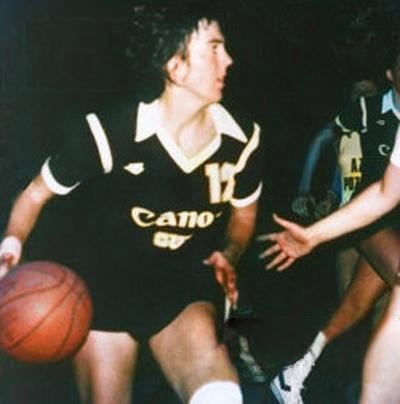
I also want to offer justifications. Chronic aching knees, for one: so painful that when I finally quit, after playing briefly for four U.S. teams, I could hardly walk.
But who or what am I shielding myself from? Why do I feel defensive, even ashamed, about competing against the best basketball players in the world, including one right there on my own team, and not quite reaching their level?
Is this a familiar feeling among other ambitious, Type A, perfectionistic folks?
My Undefeatable Doppelgänger: Olivia
My rival for the starting center position was a fierce and fabulous six-foot-three-inch leftie I’ll call Olivia,2 the only other American on the French team. Basketball is a physically aggressive, rough sport, especially for centers (now called post players). In the early days, before the three-point shot freed players to spread out, the game was all about passing the ball to the center to take short, high-percentage shots. Rebounds were our responsibility, too.
In practice, Olivia and I would crowd together like conjugal twins, trying to bruise each other out of position so we could shoot, rebound, or block each other’s shots. Olivia viciously defended her starting position with her elbows, her hips, every ounce of her 180-pound resolve. Twenty pounds lighter and an inch or so shorter, I brawled back while the coach looked on, yelling, “Rebond!” (Rebound). “Tire!” (Shoot). And, too often, this: “Bien joué (Well played)… Olivia.”
Complicating the rivalry was our close friendship, which for me developed into an unrequited crush. We had hit it off immediately upon landing in the small industrial city of Clermont-Ferrand. We gossiped in English as respite from our halting and error-filled French and blissed out over pain au chocolat from the patisserie. We laughed at ourselves while stalling our little Citroen cars, unfamiliar with the clutch. We walked home from the boulangerie carrying naked baguettes, as the French did, trying to blend in – though our team was so famous and our height so obvious that fans would approach us everywhere. (To me: “You’re the other American, right?”)
But over time, Olivia distanced herself, even requesting a different roommate on road trips, which I found not only disappointing but humiliating. Exhausted by our daily clashes on the court, we’d argue, angry voices echoing off empty bleachers.
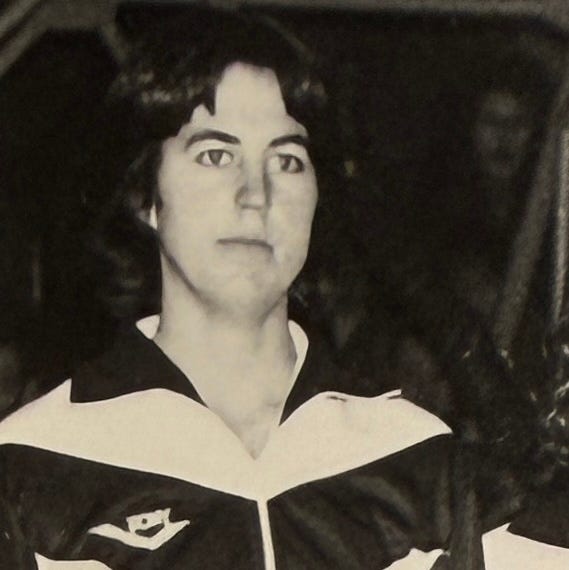
After one game, I yelled at Olivia, “Why aren’t you more supportive of me?”
“Why are you so upset?” she responded.
I had no idea. I was a frustrated, heartbroken mess.
“You should feel good about scoring 19 points tonight,” she said. “And you should stop comparing it to my 29.”
That may sound like a dig, and maybe it was, but she was probably right. Having been the star player on every basketball team since junior high, I was miserable about failing to defeat — or even match — this mirror image of myself.
I never did earn the starting position.
Here’s something I couldn’t admit at the time, though you have probably discerned it by now. Olivia was simply a better player.
The Relationship Between Secrecy and Shame
All humans accumulate failures, regrets, and humiliations, some of which we barely understand.
This bench-sitting era: This is one of mine.
Secrecy always leads to shame, I’ve noticed, and by omitting this aspect of my basketball story over the years, maybe I’ve inadvertently created a shadow story, a bench-sitting secret hidden beneath impressive phrases like “professional athlete.”
This is a coming out of sorts, a coming clean. I played professional basketball.
And I sat on the bench.
Thoughts? I’m always curious.
Other stories you might enjoy:


Most rebounds in a single game (20), broken in 2003 by Nicole Powell.
I gave “Olivia” a pseudonym in hopes of protecting her privacy.
I really love this one! And I definitely can relate, though in my case my reasons for shame aren't sports related. You write that secrecy causes shame. I agree and would add the reverse is also true, namely that shame causes secrecy. It's a vicious cycle, I think. And isn't it our self image, our ego, that drives both? It takes courage to admit our perceived failings. So in the spirit of the Hanukah season, Mazel Tov for doing that. I bet also you'll find that your "confession" won't diminish anyone's view of you as an athlete. And for you it might well be freeing.
This was a tough read, in a good way. We have all been there, I suspect. Certainly women have—whenever we have been considered “less than”—and I bet every woman reading this essay, athlete or not, can identify several examples of that. You are the best, Mariah, and this essay offers a vivid demonstration of that.