


Greetings, friends, and welcome, new subscribers!
When athletes care just the right amount about winning, we are rewarded with a unique sort of ecstacy during the competition itself, regardless of the final score.
I’ve been telling you throughout this Aspiring Cornhole Champion series that I entered the National Senior Games to feel like an athlete again.
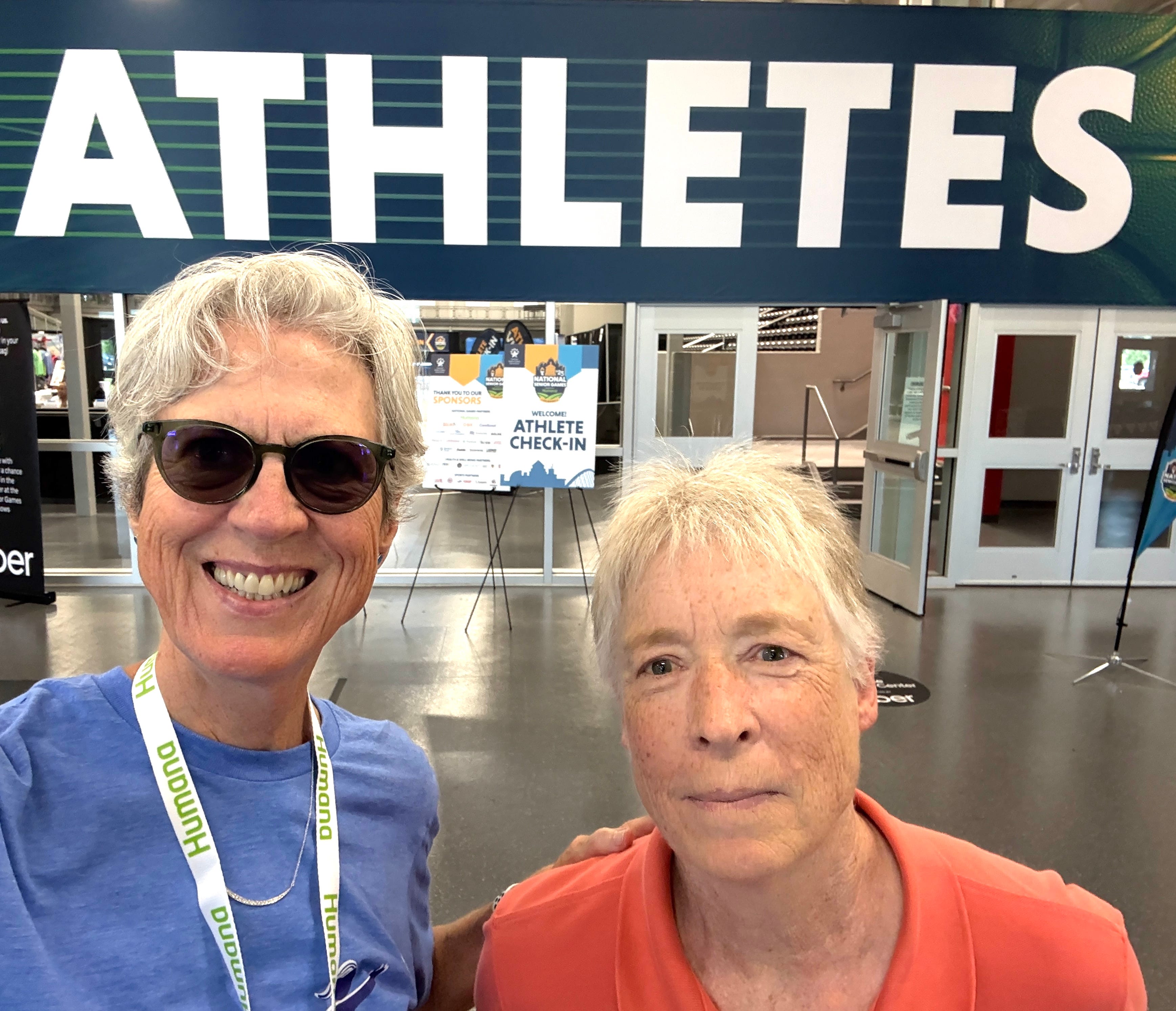
Now that I’m here at the Games (theme: Growing Bolder), I realize it’s not that I wanted to feel like an athlete again. I wanted to be an athlete again. I wanted not just to walk with an athlete’s pride and posture, but, after a long hiatus during which I limited myself to fitness rather than sports, to do the things athletes do.
Mission accomplished — because, starting in February, in preparation for the Games, I set goals. I taught myself new skills. I solicited help. I charted my improvement. I practiced the fundamentals. I developed competence and confidence by competing in small, local leagues.
Then, on August 1 and 2, I competed in singles and doubles cornhole events in Des Moines, Iowa — alongside 12,500 athletes ages 50-103 who competed in 25 sports.


I Feel Like a Teammate Again
Willie Swenholt and I won silver medals in doubles for women aged 65-69! This was a surprise, and felt like a great success and a great joy. Beforehand, we figured that anyone who drove or flew to Des Moines for a national championship was likely to have more experience — and talent — than we did. But in a field of 14 doubles teams, with a double-elimination format, we reached the championship round undefeated, having beaten several other teams and the eventual winners. Then we lost to those gold medalists twice.
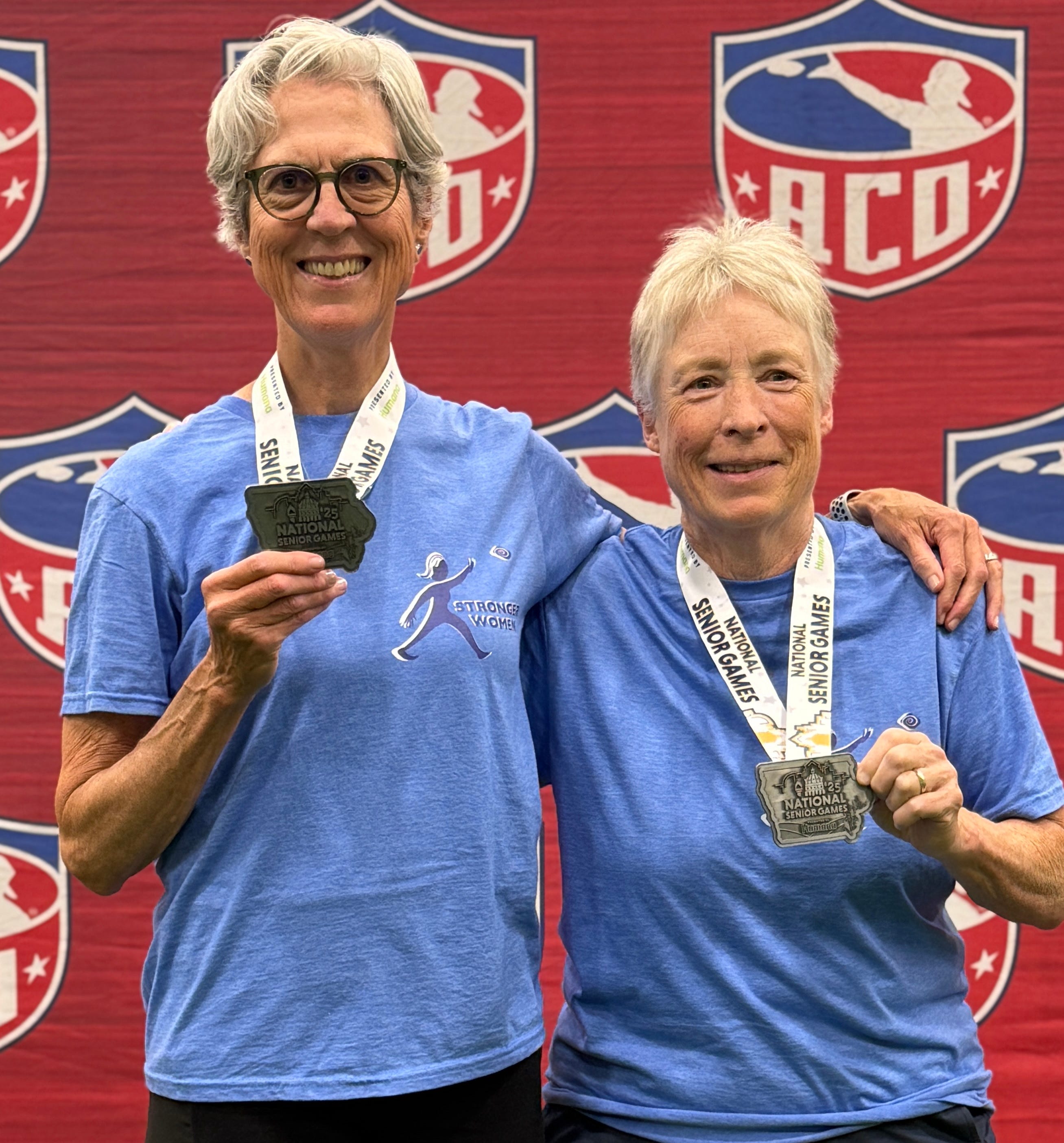
Oh well. Honestly, we were only disappointed for a minute. Those three games were so close and drama-filled they required all of the skills we could summon and thus delivered the exquisite, ineffable pleasures of athletic competition at its best. Longtime friends (we met coaching high school basketball 25 years ago), Willie and I got to be true teammates, supporting each other through the training and the games — then celebrating the surprise silver medals.
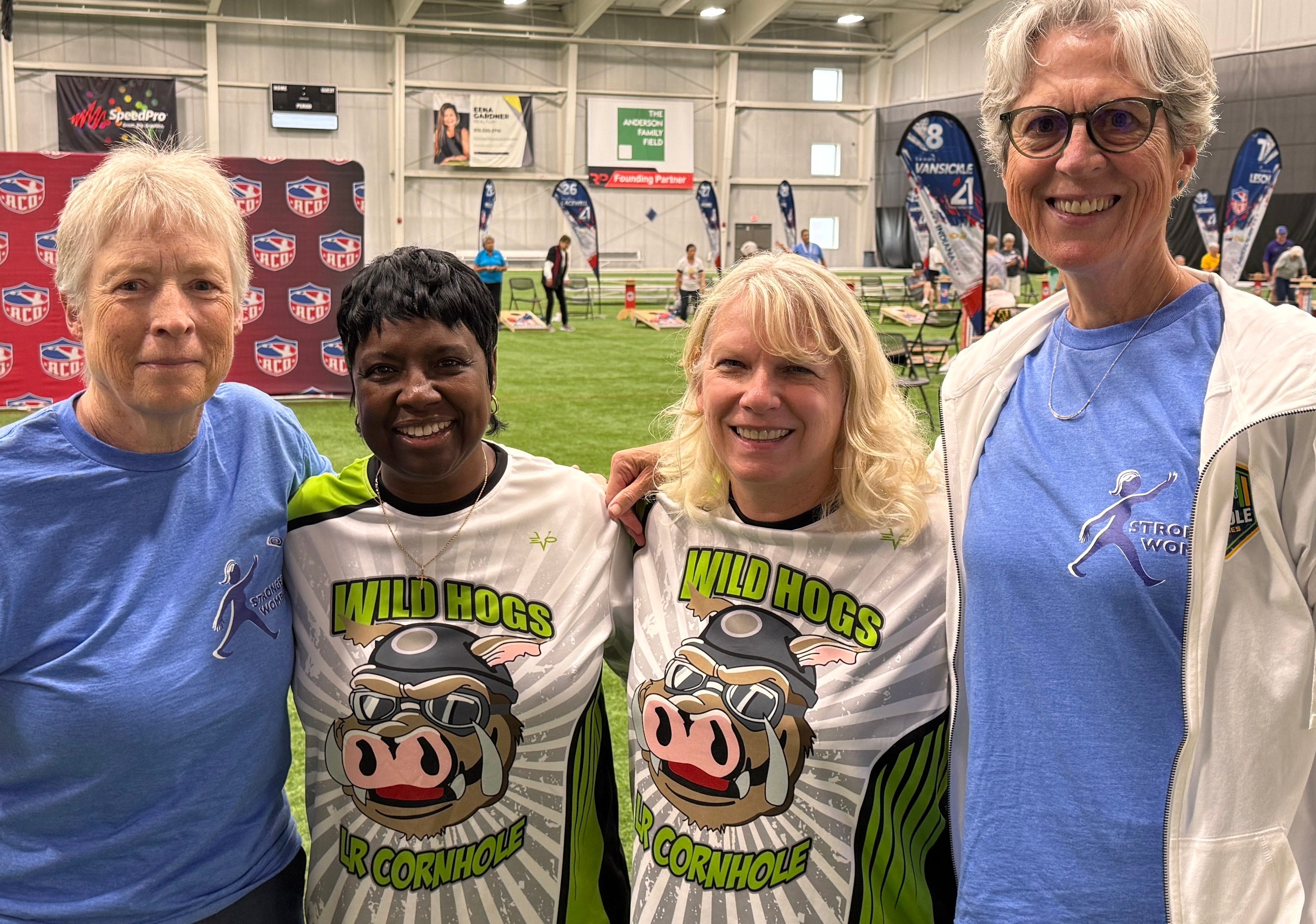
Those games also bonded us with the winners — Lucy Martin (left) and Mim Dyer, “Wild Hogs” of North Carolina, with whom we chatted and joked throughout the rest of the tournament.
The Next Day Was Singles…
As with doubles, many of my six singles matches (in a field of 33 athletes) were exciting because they were evenly matched, with the lead changing hands multiple times and an “anyone might win” uncertainty that is central to any satisfying athletic experience. They required every ounce of technique, focus, and performance under pressure that I could muster — which is “what I live for,” I want to say. That’s too extreme, but let’s say it’s one of the things I live for. I have loved swimming and rowing competitions too, but my favorite contests are games, with points and strategy and direct engagement with rivals. In the middle of one close match, where my opponent and I both threw four-baggers (perfect scores on a round), thus inspiring each other to keep reaching for perfection, I had this awareness: This is bliss.
Sports are thrilling not only when opponents are evenly matched, but when the contests matter. This is a splendid paradox: On the one hand, at this amateur level, sports are just games. It doesn’t “really” matter who wins. Yet when athletes care, we feel in the moment as if winning matters a lot. We invest our whole selves — mind and body — in seeking victory.
For some, finding perspective in the paradox can be elusive. Take competition too lightly, laughing your way through errant shots, and you won’t discover what you’re capable of. Take competition too seriously, and you’ll become an “I hate to loser,” misinterpreting defeat as a serious flaw or failing.
When athletes care just the right amount about winning, we are rewarded with a unique sort of ecstacy during the competition itself, regardless of the final score. This is what happened this weekend, during four exhausting hours of cornhole on Saturday and another four on Sunday. The immense pleasure of pursuing a physical challenge in concert with others who are trying to keep you from succeeding, which is all part of the game — is a difficult concept to explain to nonathletes. You probably know. If not, take my word for it.
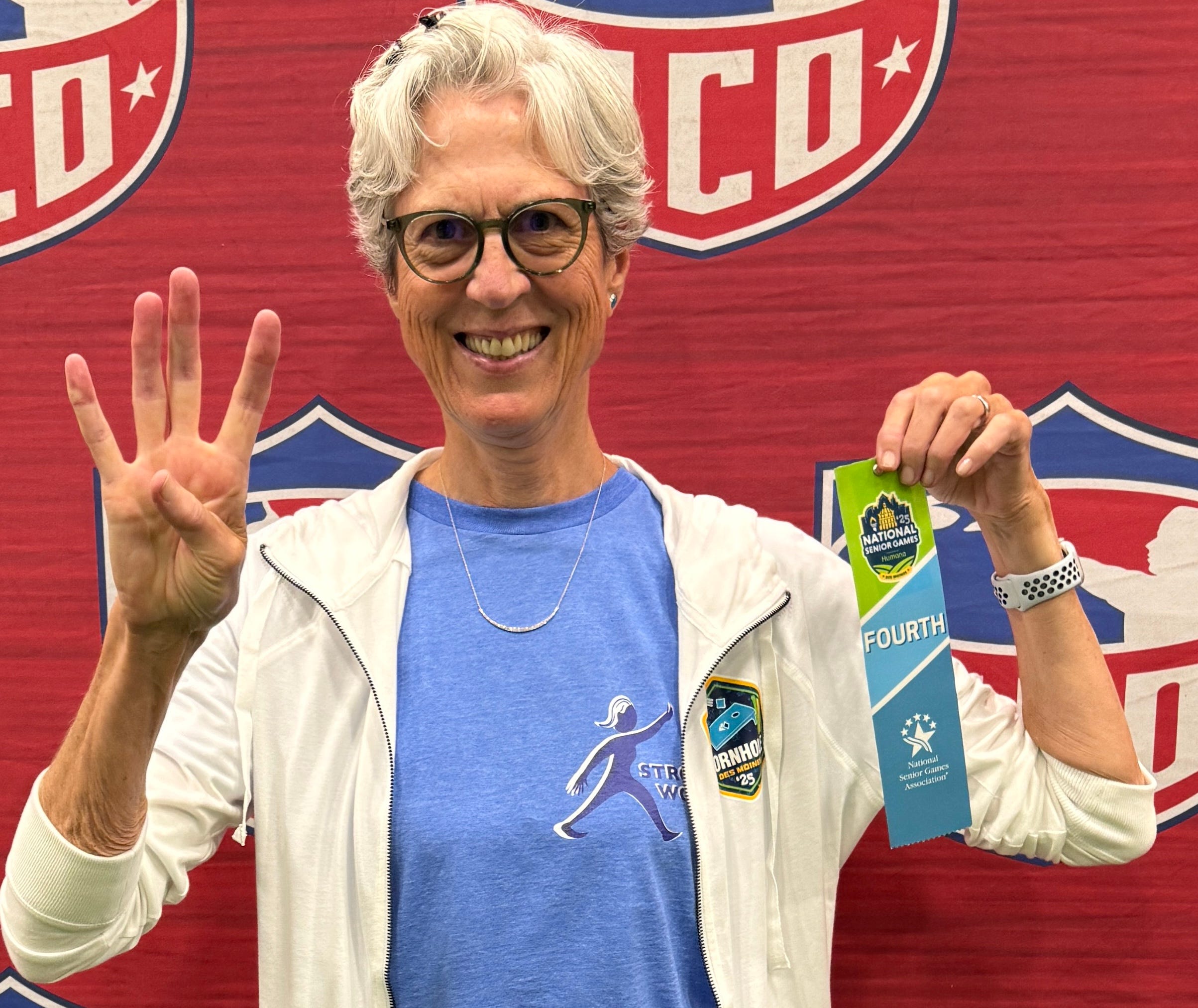
Ultimately, I placed a happy fourth.
A Few Other Notes
Willie, at 71, won gold in singles, undefeated (!) in her 70-74-year-old age group. (At 69, I remained in the 65-69 age group. For doubles, Wille needed to “play down” in my age group — because it would not have been fair for me as a younger person with the inherent performance advantage of relative youth to “play up” with those older folks in their seventies.)1
It’s a validating, empowering feeling to be surrounded by 12,500 fit, older people who, in all different body types and shapes and colors, are athletes.
In separate incidents on the same day, two female basketball players in the 70-74 age group fell and broke their hips during three-on-three play — a sobering reminder that while we may be Growing Bolder, we are also growing older — and more fragile.
My joints weathered the stress just fine, thanks to fabulous physical therapist Lyn Stewart, knee replacement two years ago, triumph over back pain, coaching from friends Bruce Batten and Nancy Hogshead, and a recent epiphany about self-care I might share another time.
For video summaries of other sports, see National Seniors Games reports on YouTube.
Then There Was the Community Surprise
Beyond my unexpected second and fourth-place finishes, the biggest surprise was that my silly-sounding Aspiring Cornhole Champion quest, which began as a personal goal, became a community celebration. Family members Carol, Peter, Linda, and Bill sent support, and Brenda delivered that support in person. Oodles of friends and Facebook pals sent texts and cheers.
My close-knit neighborhood in Rehoboth Beach, Delaware, sent three athletes to the Games, along with two spouses. Track and field-er Maryann Rapposelli (personal bests, a 5th-place ribbon, and a new sport: javelin!) and golfer Judy Wetzel (gold medal for women aged 80-84) are returning victorious, too, each in her own way. The five of us shared dinners and sat side by side on bleachers to cheer each other on as dozens of people back home sent encouragement and love, all of which felt fabulous. Thank you!


Thoughts? I’m always curious. See also:
related stories in #CornholeQuest
our Women’s Sports Policy newsletter
Like other categories, age groups exclude certain people outside the age range in order to provide more opportunities for all. Toward this end, the National Senior Games officials carefully checked our IDs before the Games and required us to sign a form swearing that we were not lying about what year we were born.
By contrast, the Games still allow males to “play down” in the women’s category if they choose the “female” box — with no proof of actual femaleness. Fortunately, I did not spot any males in the women’s cornhole competitions, nor in the other sports I observed. If I had, I would have filed a formal protest. I’ve already had discussions with the organizers about their policy. Frankly, I was dreading competing against a man, but, like virtually all female athletes, I tried to just focus on the upcoming competition instead, and largely succeeded.
Woo-hoo! Love, love, love this exhilarating, celebratory essay. The photos are terrific, all those smiles and big grins even better. Congratulations! 💥💥💥
What a wonderful experience! You are inspiring me to look into what sort of games I could still be competitive in, so that I, too, can know the thrill of being an athlete again.