


Listen to this language: “Community.” “Tribe.” “Belonging.” “Love.” “Protection.” These are not messages about eligibility, athletic fairness, or rights. They’re about belonging.
Hi Friends, Don’t you love team uniforms? They communicate: “I belong.” Left: Maureen (in cool shades) and me after another glorious ocean swim with our team. Right: Me at ten or so in my Norristown (Pa.) YWCA suit, shivering on our deck. (This was Mom’s high-concept photo: “winter swimming.”)


Have you noticed that many of the WNBA coaches and players advocating for “transgender inclusion” are lesbians? Oddly, these women are saying things that seem to contradict the raison d’être of the female sports category: women’s and men’s bodies differ in athletically consequential ways.
Why would lesbians – women! – be doing this? I have a theory: These lesbians are responding to two primal human needs they understand intimately: to belong, and to avoid rejection.
First, a few examples of these lesbian/queer/bisexual athletes and coaches: Retired WNBA pro Sue Bird actively advocates for “transgender inclusion.” Golden State Valkyries forward Gabby Williams claims she’d willingly compete with or against a transgender player. In response to Indiana Fever guard Sophie Cunningham’s assertion that women need their own sports, her coach, Stephanie White, said, “I don’t ever believe that exclusion is an answer.” Minnesota Lynx coach Cheryl Reeve wore a “Trans Kids Belong” shirt on the sidelines during a game against the Fever. And on August 24, Chicago Sky guard Natasha Cloud interrupted her own basketball game to scream at former NBA player Enes Kanter Freedom, who was wearing a t-shirt with the definition of woman: adult human female.
Read Between the Lines
Cloud’s comment after that confrontation goes a long way toward explaining lesbian support for “trans inclusion.”
“To every trans kid/person, You are apart [sic] of MY community & tribe. You belong. You’re loved. You’re seen. You’re perfect as you are. & you will always be protected by me,” she wrote on Threads.
Listen to this language: “Community.” “Tribe.” “Belonging.” “Love.” “Protection.” These are not messages about eligibility, athletic fairness, or rights. They’re about belonging.
You belong. You’re loved. You’re seen.
In fact, if you look closely, you can see that none of the athletes and coaches I’ve mentioned are specifically arguing for male athletes in female sports. Even Gabby Williams only mentions a “transgender player” – without reference to that player’s sex. To those of us watching males defeat and displace females in every sport at every level, “We favor transgender inclusion” can sound like the speaker wants to allow males into women’s sports. But this makes no sense — especially when spoken by female athletes who must know better. What’s going on?
The WNBA’s lesbian leaders seem sympathetic toward boys who adopt a trans identity. They also seem to have drunk gallons of LGBTQoolaid:
Vulnerable “trans girls” (boys) must be accommodated because “they are the most marginalized people” therefore it’s okay to deny “a few” girls and women their own rights;
To advocate for girls and women is to embolden political forces that represent a greater evil and therefore “people need to stop talking about the trans issue”; and
The WNBA need not address eligibility until a “trans woman” (male) player attempts to join the league, as if locking doors is not necessary until after theft happens.
But the WNBA’s lesbian leaders are also inadvertently pointing toward something else: a concern about their own place in the LGBTQ community.
Here’s my theory: “Inclusion” seems to function as a social signal rather than a desired eligibility rule. By not overtly proposing that we invite biological males into female sports, but instead invoking the vague word “inclusion” while sporting t-shirts with messages about children, these women seem to be trying to have it both ways: preserving their own queer credibility without actually undermining the female category to which they owe their careers.
The New York Liberty sent a related message to fans on its Jumbotron on August 22: “Welcome Trans Liberty fans! You are loved, and you belong!”
You are loved. You belong.
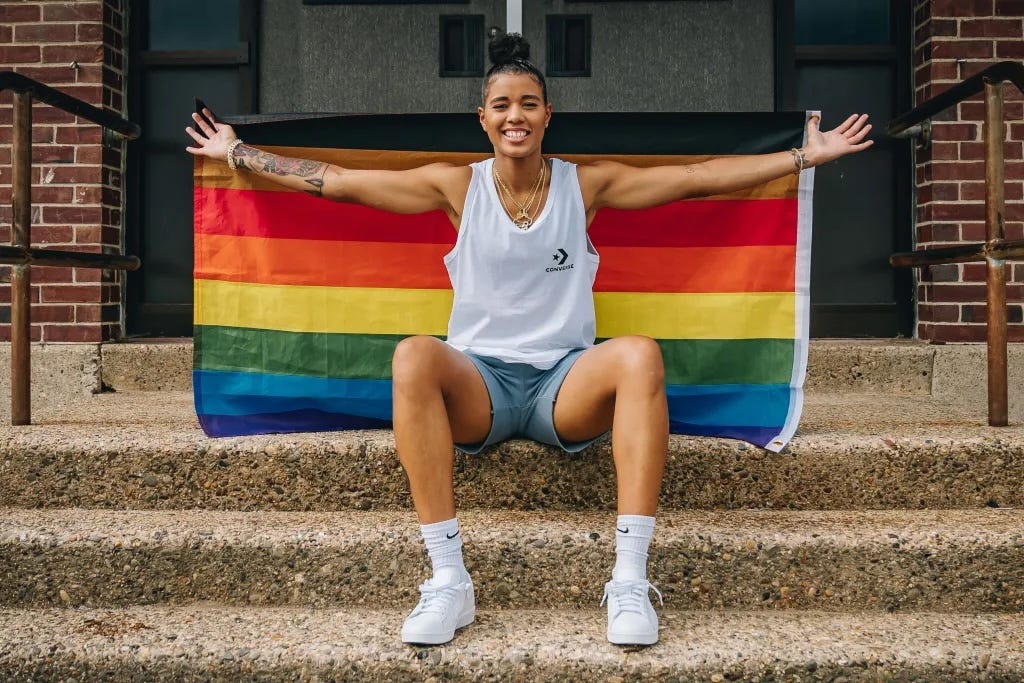
The world can be a scary place. Many lesbians seem to be circling their own female-loving wagons around the “trans women are women” crowd.
The Human Need to Belong
Like all humans, lesbians need to belong. We built our own communities – which often involved softball and other sports – in response to that need to belong. Over time, many of those communities became subsumed by the LGBTQ movement, where adherence to “transgender inclusion” and beliefs such as “trans women are women” have become defining, even requisite values. For lesbians who do not want to allow males of any gender identity into female sports and locker rooms, dissent or even direct questions can carry steep social costs, including ostracization.
There’s the rub. Everyone needs to belong. You can opt out of the official, flag-waving, LGBTQ culture, but if you refuse to toe the “trans-inclusive” party line, you’ll pay a price. Which brings me to:
The Human Fear of Rejection
Like all humans, lesbians fear rejection. Lesbians have particular reasons to fear it, involving family, legal rights, and social acceptance. These fears are heightened now. Trust me; I’m hearing this firsthand. Not just fear, but panic:
“Mariah, don’t you realize that if they take away trans rights, gay people are next?”
I get it. The world can be a scary place. To protect their beloved community, many lesbians are circling their own female-loving wagons around the “trans women are women” crowd. After all, lesbian identity is now routinely subsumed under the reign of LGBTQ, where trans is king.
Fear of rejection happens on an organizational scale, too. The WNBA has reason to fear abandonment or even revolt if its many LGBTQ-allied fans, players, and coaches feel betrayed. Hence the reassuring, “You are loved; you belong” Jumbotrons.
I Know the Costs of Dissent
I understand the conundrum faced by WNBA’s lesbian/queer/bisexual leaders better than most. I’ve been openly lesbian since 1975. I was a Stanford and professional basketball player long before women’s sports became cool. Since 1980, I’ve been a feminist sportswriter with opinions that have so enraged some misogynist men, they threatened to kill me. For six decades, I’ve been socially punished for saying and doing things girls and women aren’t supposed to say and do.
I also have lesbian former friends. They found my refusal to accept men “as women” intolerable and explained why they felt that way during long, informative rants before slamming the door.
I know the costs of dissent.
Boundaries Are Not Hateful
Exclusion is not hatred. It’s just a boundary. Women’s sports require that boundary. Without it, we would only have men’s sports or coed sports. Female athletes would lose the chance to compete on fair terms; to bond with other women; to undress and shower in peace.
I’m calling on WNBA leaders to straighten their spines and establish a clear boundary around their league – for the sake of all female basketball players, present and future – no matter the costs.
After all, women’s sports, when properly structured and protected, offer something all female athletes understand: a community of our own.
Bonus: team uniforms.
If you agree that the WNBA needs to speak up for its own female athletes — and set an example for high school girls now struggling with boys on their teams and in their locker rooms… Please sign Nancy Hogshead, JD, Oly‘s petition. And share. Thank you.
Thoughts? I’m always curious. With love and courage, Mariah
You might also like:


A lifelong athlete, feminist, and writer, Mariah Burton Nelson is the author of hundreds of articles for The Washington Post, The New York Times, and other publications, along with seven nonfiction books, including The Stronger Women Get, The More Men Love Football (Harcourt Brace). She played basketball for Stanford and in professional leagues in the U.S. and Europe.
Thank you Mariah - You’re re-igniting my fury at the men demanding in. The biggest cost to us women is the break up of the feminist, the civil rights, the gay & lesbian groups. Formerly unassailable, we are half our former strength - right when Mens sports is literally out to gut Title IX with NIL and the “Protect College Sports Act”. Breaking up the belonging, community, of having anyone … cannot be overestimated.
(It’s part of why we came together to form the Women’s Sports Policy Working Group in 2019-ish.)
Of course lesbians want safe spaces where there is no stigma.
Let me add that I feel the same abandonment by my former-peers in the civil rights legal community. I’m now a pariah in that world - one that once gave me professional community & belonging.
Major stories about sexual abuse in the AAU - and my 6 year successful battles against Rick Butler not even mentioned.
Champion Women wrote 100 complaints to the OCR about basic sex discrimination in athletics… no help from the women’s rights groups. https://titleixschools.com/2023/09/12/all-ocr-complaints-a-z/
Add this to the harms of Gender Ideology.
Mariah, THANK YOU, THANK YOU, THANK YOU! After being in this fight for a few years, I've asked my lesbian friends, both for and against, why they would want men in womens sports and spaces. They cringe and demand I recognize that "trans men are women." When I refuse, that is where the conversation goes from pleasant to hostile. One lesbian friend made a statement that floored me. Essentially she said that she follows a hierarchy of victimhood. Trans rank higher in victimhood than women. Therefore she supports trans over women (still acknowledging that they are women). Your wonderful article helped me really understand that what she was actually saying was she believes women already belong so make room for trans.